|
| Core aerate in the fall for compacted lawns |
It is the 12th of December and still our weather is unseasonably warm for our part of Pennsylvania; today is a sunny 40 degrees F (4 C), even though the temperature in early morning was 14 F (-10 C). No blanket of snow has settled yet, only a flurry
a month ago that melted in a few hours.
The nice weather has afforded me enough time this late-late fall to work on another garden problem: worn and compacted turf. It really is only in spots, but it is not so nice to begin
a walk around the garden with a stomp through the mud at the gate. Since this is a narrow spot, it gets a lot of abuse from feet big and little. And there are also a few more areas of lawn that have been reseeded each spring with little permanent success. Some more research was in order.
 |
| Gate Lawn aerated and starting to breath easier before winter wetness |
I first started thinking about core aeration when I read
Libby's post at
The Sproutling Writes. Curiously to me, she reported that they were core aerating their lawns in the fall. In my experience, homeowners in the US do that in the spring. Also, Libby reported that they raked coarse sand into the holes in their clay.
Then I went looking and found this thorough article on
Yardener about
lawn care which suggests core aeration in the fall also. This article talks about using a machine or a hand tool.
After a moment of reflection, fall core aeration made wonderful sense to me though it is an uncommon practice in the US. The purposes of core aeration are to relieve compaction, increase drainage, and stimulate root growth by root pruning. Perennial gardeners know when it is time to root prune: before winter, because it is in winter when root growth happens. Drained is also needed the most during the wet winter season. Fall coring gives your lawn all of these advantages.
Plus, Yardener's
best idea: core the lawn, then
mow in your fall leaves for mulch and break up the core plugs all at once. Brilliant! I missed my opprotunity this year, but I want to remember for next year.
More benefits to core aerating in fall instead of the spring: the kids are not outside playing in dirt plugs during this colder weather; the
crocuses blooms are not displayed above a multitude of yucky core plugs. Enough said.
A hand tool was very interesting to me since our yard is pretty small and the trouble spots even smaller. Wouldn't it be nice to be able to aerate small areas when I felt it needed it without needing to rent equipment? Especially when renting a core aerator runs $75 per day?!?
 |
| Hand Core Aerator on completed lawn |
Remember what I said about it not being a common fall practice in the US? A few visits to my local stores confirmed it: no hand aerators were available until spring. They were sold out long ago.
Since there were none available locally, I decided to order one from Amazon. I chose
Yard Butler D-6C Core Lawn Aerator for anyone interested. (Note: I am not paid for any of my product suggestions.) After having used it for a couple hours on a warmer day, I am really pleased with it. It is as sturdy as I hoped and does the job easily. It is now my second favorite tool, though far behind my
Japanese soil knife of course.
 |
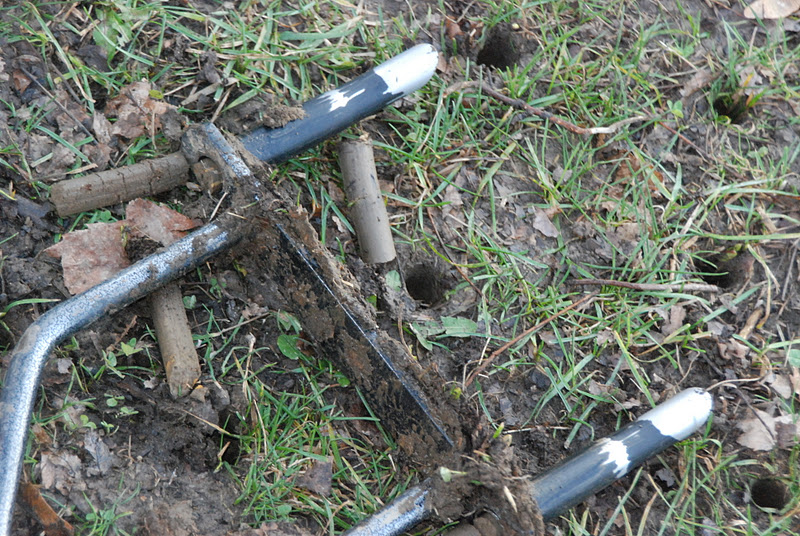
| Cores lay on the lawn to break down and add nutrients to the surface |
The process is very simple, and made much easier by having rain in the past few days. Step down on the aerator, pushing the earth into the tubes and pull the tool out. Repeat it again to push the previous cores out and make more holes. You will need to make 8-12 holes per every square foot. Leave the cores lie on top to break down over winter and add nutrients to the surface of your lawn.
 |
| You can see the previous cores coming out the top while hubby steps again. |
It really is kind of fun. There is joy in hearing the roots breath freely I guess. I do recommend wearing your gardening gloves to help with the repeated gripping involved in pulling it out. I did large sections myself in a half hour, then I wanted to stand back and let my hubby have a turn. But I was soon going at it again.
To finish up, I decided to try raking in a little coarse sand as Libby suggested for her clay turf (see top photo). I am hopeful that it will increase the drainage even further in these compacted areas and help our turf mixed with white clover struggle to success.
Fall Gardening Tasks Series:
#2 New perennials for fall planting
# 7 Edging and Removing Turf
#8 Heeling in- Quick Winter Perennial Storage